|
Savage went to Philadelphia
in 1795, where from July he exhibited his panorama of London.
The following February he opened the Columbian Gallery, "a
large collection of ancient and modern Paintings and Prints."
(Gazette of the United States, 20 February 1796). From then until
1801 he worked in Philadelphia as a painter, engraver, print
publisher and gallery operator. Although his painting and engraving
techniques had improved in England, he relied considerably on
the assistance of his apprentice John Wesley Jarvis and English
engraver David Edwin. Later they and others claimed that their
talents added significantly to the quality of Savage's work in
these years.
Savage exhibited his London
panorama in New York in 1797 and moved there in 1801, where he
reopened the Columbian Gallery. He is listed in New York city
directories through 1810 as a "historical painter and museum
proprietor". Gallery exhibits included his paintings of
The Washington Family, Liberty, The Landing of Columbus ("from
a picture in the collection of the Grand Duke of Tuscany")
and his copy of West's Cupid Stung by a Bee. Engravings of "Liberty,
Columbus, Etna, Vesuvius, a large whole length of Washington...and
many other Prints published by E. Savage" were for sale.
The museum offered natural history exhibits that were "arranged,
agreeably to the ideas of Sir Hans Sloane, and with the addition
of a number of paintings, and other interesting articles, will
form a complete source of amusement for every class, particularly
the amateurs of Arts and Sciences." (The Daily Advertiser
10 June 1802). Charles Bird King was a pupil in 1800-1805. In
the winter of 1805-1806 he and Charles Willson Peale exchanged
natural history specimens. The following summer he made a sketching
trip to Niagara Falls
Savage went briefly to Baltimore
in 1810, where he advertised as a portrait painter in March (American,
and Commercial Daily Advertiser, 19 March 1810). He moved that
year to Boston, where he re-established the Columbian Museum
on Tremont Street. He died seven years later, in 1817, on his
farm in Princeton, Worcester County, Massachusetts. One of many
talented artists of the Federal period, Savage is best remembered
as one of the first proprietors of a museum and picture gallery.
[This is an edited version of the artist's biography published,
or to be published, in the NGA Systematic Catalogue] |

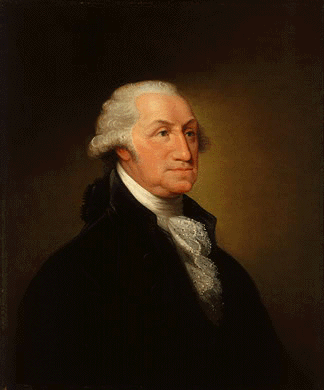
 Edward Savage