Historian George W. Williams in History of
the Negro Race in America described the Boston
Massacre as "the bloody drama that opened the most eventful
and thrilling chapter in American history." Neither
a soldier nor a leading town citizen proved the hero of that
pre-Revolutionary War struggle. Instead, the first of five men
to die in the massacre was a runaway slave turned sailor, Crispus
Attucks.
His death has forever linked his name with the cause of freedom.
Historians know little about Attucks, and they have constructed
accounts of his life more from speculation than facts. Most documents
described his ancestry as African and American Indian. His father,
Prince Yonger, is thought to have been a slave brought to America
from Africa and that his mother, Nancy Attucks, was a Natick
Indian. Researcher Bill Belton identified Attucks as "a
direct descendent of John Attucks, an Indian executed for treason
in 1676 during the King Philip War." The family, which may
have included an older sister named Phebe, lived in Framingham,
Massachusetts.
Apparently, young Attucks developed a longing for
freedom at an early age. According to The Black Presence in
the Era of the American Revolution, historians believe that
an advertisement placed in the Boston Gazette on October 2, 1750,
referred to him: "Ran away from his Master William Brown
from Framingham, on the 30th of Sept. last, a Molatto Fellow,
about 27 Years of age, named Crispas, 6 Feet two Inches high,
short curl'd Hair, his Knees nearer together than common: had
on a light colour'd Bearskin Coat." The owner offered
a reward of ten pounds for the return of the slave and warned
ship captains against giving him refuge. George Washington Williams
noted that the advertisement appeared again on November 13 and
November 20. Biographers surveyed that Attucks escaped to Nantucket,
Massachusetts, and sailed as a harpoonist on a whaling ship.
Historians definitely place Attucks in Boston in March
of 1770. While in Boston, probably awaiting passage on a ship
to the Carolinas, he found a job as a dockworker. Some writers
proposed that he was using the name Michael Johnson. Assuming
that the Boston Gazette advertisement did refer to him, he would
have been about 47-years old.
~ The Boston Massacre ~
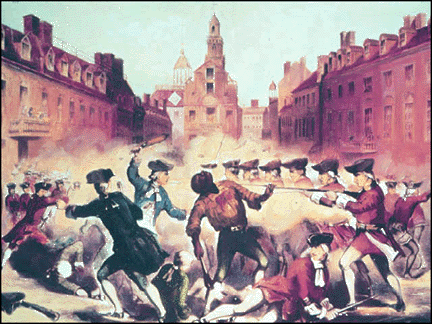
Boston Massacre. Henry Pelham, stepbrother of painter
John Singleton Copley.
Pelham published his design nearly two weeks after Paul Revere's.
By 1770 Boston had become "a storm center of brewing revolt,"
according to Benjamin Quarles in The Negro in the American
Revolution. The British had stationed two regiments in the
city following protests by the colonists against unfair taxes.
Citizens welcomed neither the troops walking the streets nor
the two canons aiming directly at the town hall.
Describing the setting, historian John Fiske explained in Unpublished
Orations that "the soldiers did many things that greatly
annoyed the people. They led brawling, riotous lives, and made
the quiet streets hideous by night with their drunken shouts.
... On Sundays the soldiers would race horses on the Common,
or would play `Yankee Doodle' just outside the church-doors during
the services."
As tensions mounted, the atmosphere grew ripe for
confrontation. Fiske pointed out that during February of 1870,
"an unusual number of personal encounters" had occurred,
including the killing of a young boy. Regarding the evening of
March 5, 1770, he explained, "Accounts of what happened
are as disorderly and conflicting as the incidents which they
try to relate." A barber's apprentice chided a British soldier
for walking away without paying for his haircut. The soldier
struck the boy, and news of the offense spread quickly. Groups
of angry citizens gathered in various places around town. Someone
rang the church bell and such a summons usually meant that a
fire had broken out. This night, however, it presaged an explosive
situation between the soldiers and the townspeople.
Captain Thomas Preston called his Twenty-ninth Regiment
to duty. Townspeople began pelting the troops with snowballs.
From the dock area, a group of men, led by the towering figure
of Attucks, entered King Street, armed with clubs. Some accounts
maintained that Attucks struck soldier Hugh Montgomery. Others,
for example, John Fiske, stated that he was "leaning upon
a stick" when the soldiers opened fire. However the incident
occurred, Attucks lay dead, his body pierced by two bullets.
Ropemaker Samuel Gray and sailor James Caldwell also died in
the incident. Samuel Maverick, a 17-year-old joiner's apprentice,
died the next day. Irish leather worker Patrick Carr died nine
days later, and six others were wounded. Citizens immediately
demanded the withdrawal of British troops. Fiske noted in Unpublished
Orations that the deaths of these men "effected in a
moment what 17 months of petition and discussion
had failed to accomplish."
John Adams reluctantly agreed
to defend the British soldiers, two of whom were charged with
manslaughter and branded. At the trial, Adams focused on Attucks,
portraying him as a rabble-rouser. Because of accounts given
at the trial, some historians have questioned the motives of
the massacred men. Fiske evaluated that although we cannot know
their motives, "we may fairly suppose them to have been
actuated by the same feelings toward the soldiery that animated
Adams and Warren and the patriots
of Boston in general."
~ Boston Honors ~
The town's response to the murders expressed the significance
of the sacrifices these men made. The bodies of Attucks and Caldwell
lay in state at Faneuil Hall; those of Gray and Maverick lay
in their homes. For the funeral service, shops closed, bells
rang, and thousands of citizens from all walks of life formed
a long procession, six people deep, to the Old Granary Burial
Ground where the bodies were committed to a common grave. Until
the signing of the Declaration of Independence,
Boston commemorated their deaths on March 5, "Crispus Attucks
Day." According to Ted Stewart in Sepia, Boston abolitionist
Wendell Phillips stated on the first such occasion, "I place...this
Crispus Attucks in the foremost rank of the men that dared."
Through the years, people have remembered Attucks
in a variety of ways. Paul Revere created
a woodcut of the incident, and the National Archives housed a
painting by noted New England artist Benjamin Champney depicting
the event. Negro military companies took the name "Attucks
Guards." Poets dedicated works to his memory, and communities
named schools after him.
In 1888 Boston erected a monument to the heroes of
the massacre which James Neyland in Crispus Attucks called
"the first ever to be paid for by public funds" in
Massachusetts. City officials had rejected earlier petitions
for such a monument. Even in 1888, various Boston factions heatedly
debated the appropriateness of this gesture. At the unveiling,
speaker John Fiske called the Boston Massacre "one of the
most significant and impressive events in the noble struggle
in which our forefathers succeeded in vindicating, for themselves
and their posterity, the sacred right of self-government."
In his 1995 biography, James Neyland wrote about Attucks:
"He is one of the most important figures in African-American
history, not for what he did for his own race but for what he
did for all oppressed people everywhere. He is a reminder that
the African-American heritage is not only African but American
and it is a heritage that begins with the beginning of America."
Although obscure in life, Attucks played an important
role in U.S. history through his death. Bill Belton in the Negro
History Bulletin contended that the name of Crispus Attucks
will stand "forever linked to the birth of this nation and
its dream of freedom, justice, and equality."
The debate notwithstanding, Attucks, immortalized
as "the first to defy, the first to die," has been
lauded as a true martyr, "the first to pour out his blood
as a precious libation on the altar of a people's rights." |

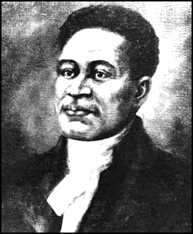

 Crispus Attucks